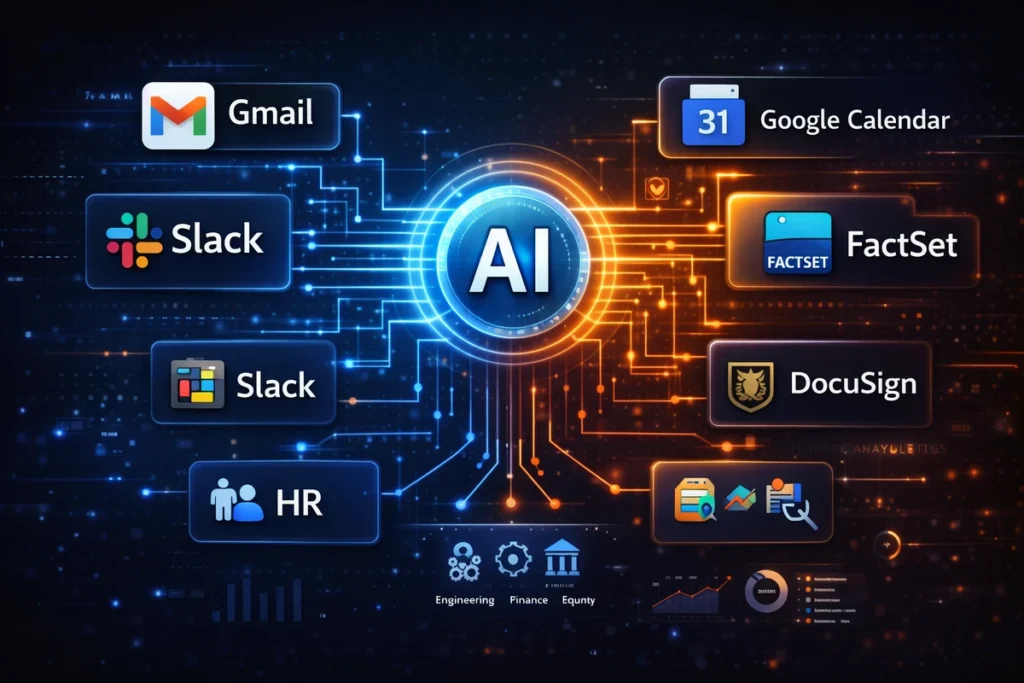
AI is transitioning from a productivity tool into operational infrastructure embedded across enterprise workflows. Recent market activity shows organizations prioritizing automation at the board level while deploying agentic systems across finance, development, and procurement to reduce cost and increase execution speed.
Organizations are no longer experimenting with AI. They are operationalizing it.
Why this trend is accelerating
Industry reporting shows enterprise AI has become a strategic imperative rather than an innovation initiative. Corporate leadership is treating AI adoption as a competitive necessity, with companies embedding automation into operational processes and workforce transformation strategies. Financial institutions, software vendors, and enterprise platforms are investing heavily in AI training, workflow tools, and automation infrastructure.
At the same time, e‑commerce operators are seeing measurable performance tied to digital execution improvements, highlighting how operational automation directly impacts revenue and conversion.
Business implications for founders and operators
The emergence of agentic AI and embedded automation introduces new structural advantages:
– Reduced operational overhead through automated workflows
– Faster decision cycles in procurement, finance, and customer operations
– Improved forecasting through AI‑driven analytics
– Stronger competitive positioning through data‑centric infrastructure
Automation is increasingly becoming a cost structure decision rather than a technical experiment.
Developer implications and system design
Engineering teams must adapt to AI‑native architectures:
– API‑first systems that allow agents to execute tasks
– Workflow orchestration layers connecting internal tools
– Observability and human‑in‑the‑loop governance
– Data pipelines designed for retrieval and reasoning
Agent‑driven execution models are replacing static automation scripts.
Monetization opportunities
1. AI workflow SaaS for finance, HR, and operations
2. Automation consulting and integration services
3. Vertical AI agents tailored to industry workflows
4. Data platforms powering predictive operations
5. Marketplace ecosystems for plug‑in automation
Organizations that convert internal automation into customer‑facing products create recurring revenue streams.
Actionable implementation roadmap
Step 1: Identify repetitive workflows tied to measurable costs.
Step 2: Deploy AI copilots for operational tasks.
Step 3: Introduce agent orchestration across tools.
Step 4: Establish governance, approvals, and monitoring.
Step 5: Scale automation into revenue‑generating services.
Internal linking opportunities
– AI automation playbooks
– Enterprise agent architecture guides
– AI monetization strategies
– Data infrastructure best practices
Authoritative external references
– Enterprise leaders are prioritizing AI adoption as essential for competitiveness.
– E‑commerce performance improvements linked to digital operational execution.
– Workforce transformation initiatives tied to AI adoption across banking and enterprise sectors.
Future outlook
By the end of the decade, most enterprise software will be AI‑orchestrated. Organizations that implement agent‑driven automation early will control cost structures, operational speed, and market responsiveness. Developers who build composable automation systems will become critical to enterprise infrastructure.