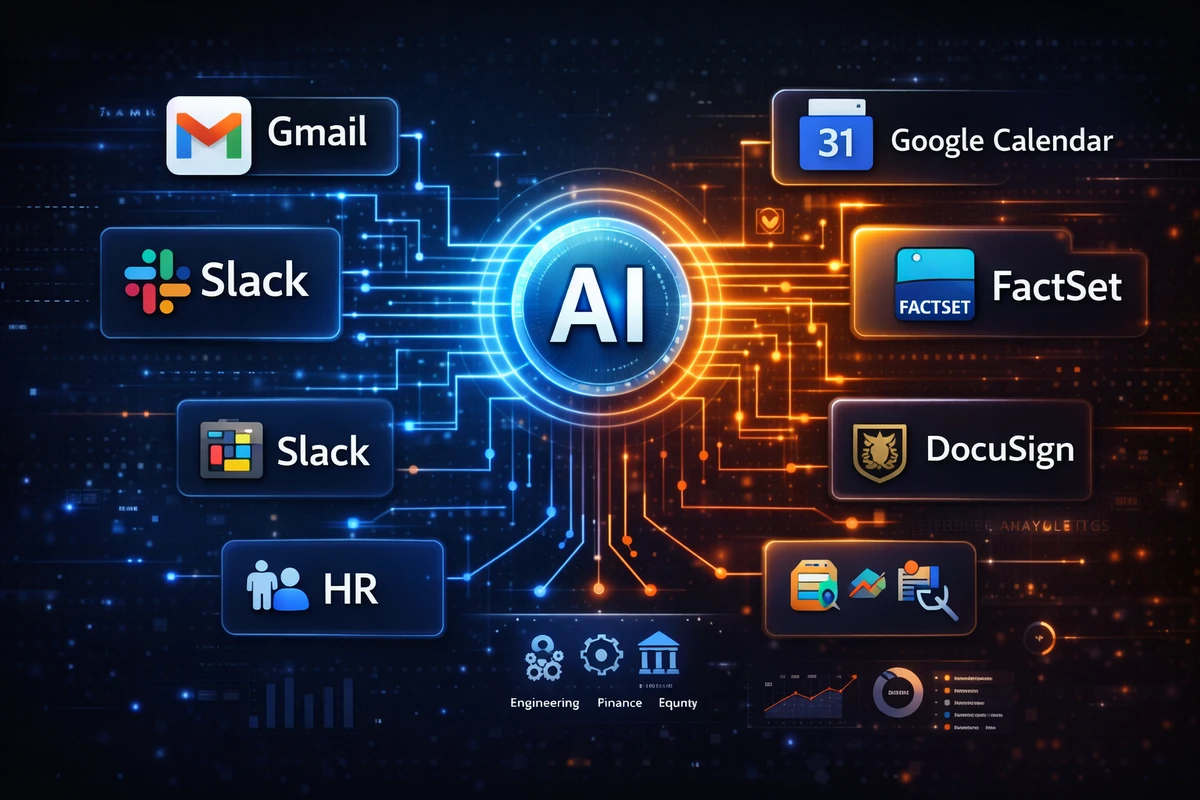
Enterprise AI is shifting from “chat in a box” to embedded, workflow-native tools. This week, Anthropic announced a set of new enterprise-focused plug-ins to push Claude into day-to-day knowledge work—covering functions like finance, HR, private equity, engineering, and design—with integrations that connect to widely used business apps (including Gmail and Google Calendar) and partners such as LSEG, FactSet, Slack, and DocuSign.
Why this matters now
- AI adoption is moving to where work happens: users want fewer tabs and less copy/paste—AI inside the tools they already use.
- IT buyers prefer “plug-in” procurement: integrations are easier to justify than a full platform replacement.
- Automation risk is becoming a board-level topic: the market is watching which workflows get automated first and how vendors price that disruption.
Business owner view: the monetization playbook
If you run a services firm, SaaS product, agency, or a niche vertical business, plug-in ecosystems are a new distribution channel. The winners will package business outcomes (time saved, risk reduced, faster approvals) instead of “AI features.”
Fast, practical moves you can execute in 30 days
- Pick one workflow with measurable ROI: e.g., contract intake triage, renewal quote generation, invoice exception handling, or candidate screening summaries.
- Define a “before vs after” KPI: turnaround time, error rate, cost per case, escalation rate, or customer response time.
- Offer a paid pilot: fixed-scope deployment (2–4 weeks) with success metrics and a clear handoff plan.
- Bundle governance as a product: audit logs, approvals, policy prompts, and role-based access become paid add-ons.
Revenue models that fit plug-in-first AI
- Outcome-based retainers: price per workflow automated or per department supported.
- Seat + usage hybrid: a base subscription plus metered calls for high-volume tasks (summaries, extraction, document review).
- Implementation + managed ops: set up once, then charge monthly for monitoring, tuning, and compliance reporting.
Developer view: what to build (and what buyers actually pay for)
Enterprise buyers pay for reliability, auditability, and integration depth. “Smart prompts” are easy to copy. Systems that reduce risk and friction are defensible.
High-demand build ideas
- Connector + permissions layer: unify data access (email, calendar, docs, CRM) with least-privilege controls and scoped tokens.
- Approval-aware agents: draft, route for human signoff, then execute (send, file, update records) with an audit trail.
- Document-to-structured-data pipelines: contracts, HR forms, investment memos → validated JSON + confidence scoring + exception queues.
- Observability & safety: prompt/version management, redaction, PII policies, and incident replay for compliance teams.
- Attribution dashboards: show time saved, steps eliminated, and where the agent escalates—this justifies renewals.
Reference architecture (simple and sellable)
- Ingestion: event triggers from email/calendar/docs + webhooks
- Policy: org rules + role controls + redaction
- Reasoning: Claude task execution with tool calls
- Actions: write back to CRM/ERP, create tickets, send drafts
- Proof: logging + metrics + approvals
Internal linking suggestions
- Agentic workflows: how to design approvals and audit logs
- Enterprise AI ROI: measuring time saved vs risk introduced
- Building secure connectors: Gmail/Calendar/Docs integration patterns
Authoritative external references
- Reuters: Anthropic touts new AI tools and enterprise plug-ins
- WSJ: Anthropic pushes Claude deeper into knowledge work
FAQ
Common questions teams ask when evaluating enterprise AI plug-ins and workflow integrations.